
By Joseph Era | IT Consultant & Solutions Architect
A few days ago, I read the news surrounding a catastrophic digital banking outage in Paraguay. A systemic disruption across centralized cloud networks, payment routing, and international gateway dependencies suddenly rendered an entire national banking ecosystem inaccessible.
In a matter of hours, millions of citizens were locked out of their accounts. Merchants couldn't clear point-of-sale transactions, local supply chains ground to a halt, and everyday municipal operations froze—not because the banks ran out of liquidity, but because the digital connective tissue sustaining the system failed.
Watching that collapse unfold made me ponder our own reality here in the Philippines.
As an IT consultant, systems developer, and solutions architect who builds enterprise systems, I often see software built around a dangerous default: the assumption that the cloud is an unbreakable, infinite pipeline. We move everything to multi-region foreign clouds, rely on third-party international APIs, and treat subsea fiber optic cables like immortal fixtures of the earth.
Hyper-connectivity lets us build incredible things. But as an architect, I know a fundamental truth: any system designed with a single point of failure will eventually fail.
And for an archipelagic nation like the Philippines—spanning more than 7,000 islands with complex physical boundaries—our complete reliance on centralized, foreign digital rails is a major strategic vulnerability.
If a digital disruption like Paraguay's can freeze a landlocked country, what happens when global networks flicker out across an archipelago?
The Math of Deglobalization: From Exponential Growth to Baseline Survival
In complex systems theory, knowledge sharing and technological capacity scale non-linearly. When global networks are healthy, international data exchange acts as an exponential multiplier. We can model a nation's innovation and operational learning rate (L) using a globalization multiplier:
L = L0 · kG
Where L0 is your baseline local problem-solving capacity, and G represents your level of global network integration. When global connectivity is fully active (G > 0), that exponent multiplies our technological output exponentially.
But what happens when geopolitical tensions, cyber warfare, or physical subsea cable failures force a sudden disconnect? When globalization contracts to zero (G → 0), that exponential multiplier drops back down to 1:
L = L0 · k0 = L0 · 1 = L0
If a country relies entirely on external cloud providers without a sovereign internal fallback, it doesn't just experience a slow lag—it undergoes acute civilizational regression. Municipal services blind themselves, payment networks drop offline, and supply chains break.
The Solution: The Archipelago Protocol
To prevent this kind of systemic failure, we need a fundamental shift in how both enterprise architects and government agencies approach digital infrastructure. We cannot only optimize for speed and cloud efficiency; we must optimize for civilizational resilience.
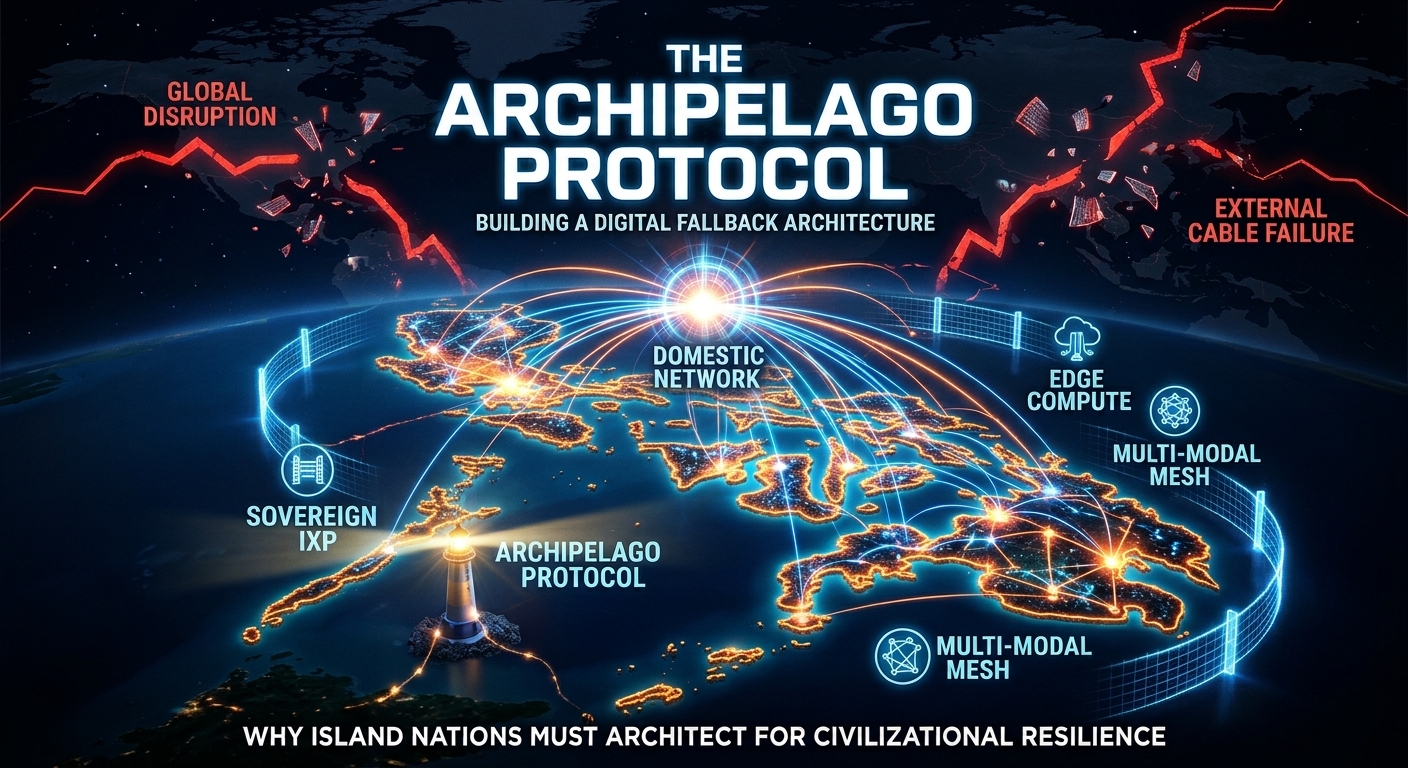
I have been working on a formal mathematical and architectural model called The Archipelago Protocol—a framework designed to help the Department of Information and Communications Technology (DICT) and enterprise leaders decouple internal transaction capacity from external dependencies.
To build a resilient archipelagic network, public sector and enterprise architecture must focus on three core pillars:
1. Eliminating Data “Tromboning” via Local IXPs
Currently, a significant portion of domestic internet traffic in the Philippines suffers from “tromboning”—where data passing between two local points gets routed out to international switches or regional hubs abroad before coming back. The DICT must spearhead policies that force intra-national data to peer locally through sovereign, distributed Internet Exchange Points. If international links sever, internal communications stay live.
2. Decentralized Edge Compute & Offline-First Architecture
Cloud-first strategy becomes a single point of failure when the cloud becomes physically unreachable. We must push compute capabilities to the edge. Primary national registers, health databases, land titles, and financial clearing services should be mirrored across regional edge data centers in Luzon, Visayas, and Mindanao. By enforcing offline-first architectural standards, municipal governments can maintain transaction continuity during global blackouts.
3. Fault-Tolerant Inter-Island Mesh Redundancy
An archipelago cannot depend solely on fragile, single-path subsea cables vulnerable to anchor drags or natural disasters. We need a multi-modal transport backbone—combining subsea fiber loops with software-defined microwave links, high-throughput local mesh relays, and sovereign control over Low Earth Orbit (LEO) satellite ground stations.
The Architect's Takeaway
Technology is no longer just a commercial tool; it is the central nervous system of modern civilization. What happened in Paraguay was a clear warning shot for sovereign nations everywhere.
As solution architects and tech leaders, our job isn't merely to design systems that run fast on a good day. It is to architect systems that survive the worst day. By treating domestic connectivity as a civilizational buffer, the DICT can transform our geographic fragmentation into a matrix of strategic resilience.
When the global network flickers out, the only systems that will save us are the ones built to survive right here at home.