By Joseph Era | IT Consultant & Solutions Architect
Every year around November 5, the security community braces. The date — Guy Fawkes Day — has become the hacktivist calendar's flashpoint, marked annually by the Million Mask March, also known as “Operation Vendetta,” and associated with the loose collective Anonymous. It is not folklore: threat-intelligence records show hacktivists have deliberately timed cyberattacks to coincide with November 5. Defacements and politically motivated breaches cluster around “V-Day,” and the days around it have become an unofficial hacking season.
This year, that season landed on ground that was already burning.
2026: A Year the Websites Went Dark
Two waves defined the year, and both ended the same way — with strangers running commands inside systems they were never supposed to touch.
The first was a global web-shell campaign against content management systems. In July 2026, Australia's cyber agency issued a critical alert over a large-scale campaign targeting CMS platforms and their plugins. The playbook was industrial: scan the open internet for known CMS and plugin flaws, exploit an unauthenticated file upload or code-execution bug, and plant a web shell for persistent remote access. Once that shell is live, the attacker can deface the site, steal credentials, and reach the databases behind it.
The second was WP2Shell. Researchers disclosed a chain of WordPress Core flaws — rated a near-maximum severity and exploitable with no login at all — that let an attacker create an administrator account and install a plugin-based web shell on millions of sites. Full takeover, no password required.
And underneath all of it, in October, the PHP project shipped emergency patches for “PHP2Shell” — a pair of critical flaws in the language runtime that powers most of the web. That one isn't a CMS bug at all; it's deeper, in the engine the CMS runs on. Governments and companies pulled services offline rather than risk it.
The Pattern Nobody Wants to Say Out Loud
It's tempting to read this as a patching problem — if everyone just updated faster, we'd be fine. That's comforting, and wrong.
Look at how government sites actually fall. The attacker rarely guesses a password. Instead, a known weakness in the content management system — or one of its plugins, themes, or the runtime beneath it — hands them the ability to run code on the server. From that foothold they trace the web of applications and databases wired to the CMS, move sideways, and quietly pull the data out. The CMS wasn't just a way in. It was the way in.
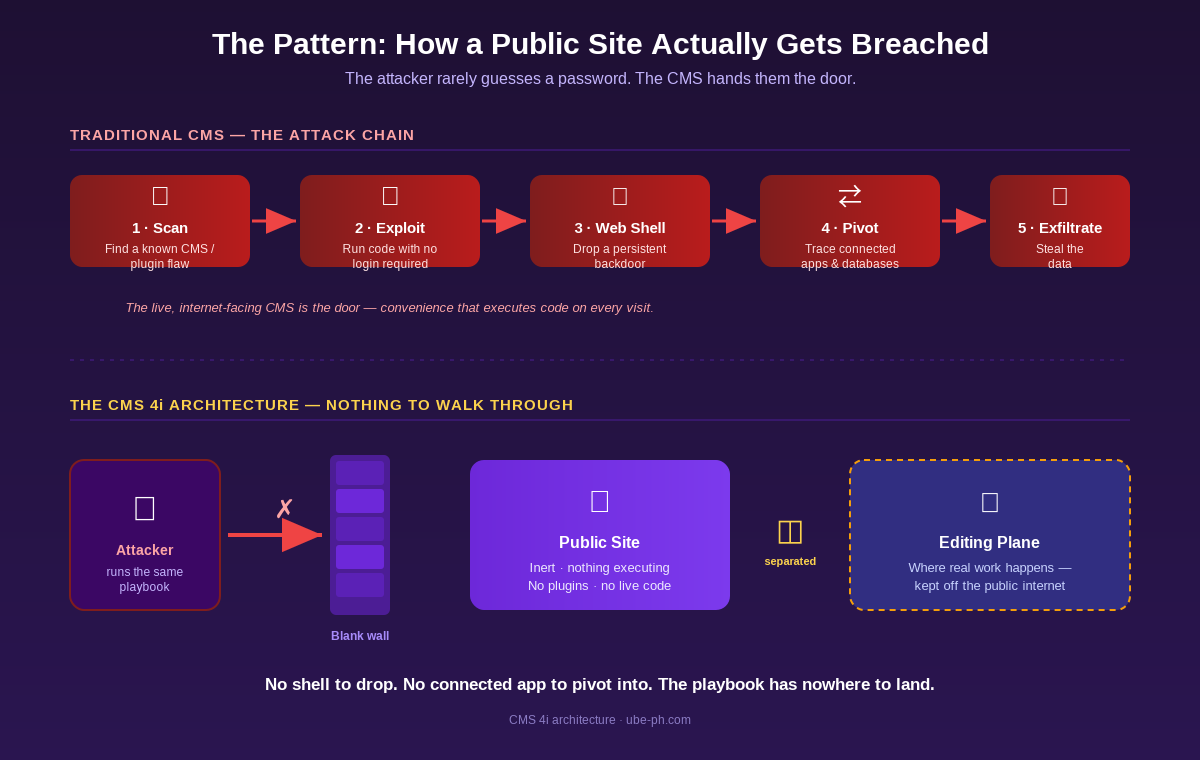
The breach chain on a traditional CMS (top) versus the architecture CMS 4i is built on (bottom): remove the executable public surface and the playbook has nowhere to land.
Here is the uncomfortable truth: the thing that makes a traditional CMS convenient — a live, internet-facing application that executes code on every page view, extended by a marketplace of third-party plugins, sitting directly on top of your database — is the exact same thing that makes it a target. Every plugin is new code someone else wrote. Every dynamic page is a place to run a command. The convenience is the attack surface.
You cannot patch your way out of a design that puts an executable, extensible, database-connected application on the public internet and leaves it there. You can only shrink the window between “flaw disclosed” and “flaw exploited” — a window that, in 2026, closed in hours.
So We Removed the Door
Instead of reacting to every zero-day disclosure with a frantic patch cycle, the architecture itself needs to change.
We have developed our own CMS, CMS 4i. It is the platform that delivers the 4i framework content methodology (which we also formulated) — how information and flow are organized so users find what they need. But the underlying architecture is a deliberate engineering decision to take the attacker's target off the public internet entirely.
The principle is simple to state and hard to argue with: a public website should have nothing on it for an attacker to exploit.
No live application executing code on each visit.
No plugin marketplace exposed to the world.
No direct line from a public page to your database.
The part of the system people can reach is completely inert — there is simply no running machinery there to compromise. The part that does the real work — where content is created and managed — is kept strictly separate from the public, so a visitor (or an attacker) never touches it.
When there is no shell to drop and no connected application to pivot into, the entire 2026 playbook — scan, exploit, web-shell, pivot, exfiltrate — has nowhere to land. The web-shell campaigns, WP2Shell, even a runtime flaw like PHP2Shell: all of them need something executing on the public edge to attack. Remove that, and the door they walk through isn't just locked. It isn't there.
Before the Next V-Day
Vendetta Day will come around again. So will the next critical CMS disclosure, and the one after that. The question for any agency or business running a public site is not “are we patched?” — it's “if we're breached tomorrow, what can they actually reach?”
If the honest answer is “our CMS, and everything wired to it,” you are one disclosure away from a bad week. CMS 4i is built so the answer is “nothing worth having” — a website with no door to walk through, delivered through the proven 4i content methodology.
Get your site off the target list. Subscribe at cms4i.app — then let's talk about moving you onto an architecture that simply has nothing for an attacker to exploit.
For more on the content methodology behind it, read the 4i Framework paper.